So I never got around to posting my Lake Erie blog...oops.
Lake Erie has lots of birding spots, and the first place we went to was Sheldon Marsh in Huron, Ohio. There, we heard and saw:
several White-throated Sparrows
Blue Jay
Slate-colored Junco
Black-capped chickadee
Mallard
Herring gull
Bonaparte's gull
Ring-billed gull
Ruddy ducks
The next day we went to a different area, and we saw a ton of duck species there, including:
Bufflehead
Redhead
Lesser Scaup
Mallard
Canada Goose
Lesser Tern
American Coot
Bonaparte's gull
Double-crested cormorant
Herring gull
Greater black-backed gull
Fox Sparrow
Northern shoveler
Gadwall
Slate-colored Junco
Blue-winged teal
Both nights we were in Lake Erie we went banding for the Northern Saw-whet Owl, which is the smallest owl species in the Eastern US. The first night we were unsuccessful, but the second night we managed to catch one!
As much fun as waking up at 6:15am is, that joy is only amplified when it isn't even forty degrees outside. For the first time this season, I wore my winter coat outside, and I did not regret that decision at all!
We left OU at 7:15 to drive to the Ridges, where we netted once again. Despite being totally frigid, it was a clear and sunny morning. Most of the birds we caught today were very common. For example, we caught more Carolina chickadees and tufted titmice. We caught a whopping NINE chipping sparrows. Despite an overall high number of captures, only two of the species today were new to us.
The song sparrow
Copyright: Ed Schneider
The song sparrow is an extremely common bird in the US, and if you haven't seen one, then you've definitely heard one.
While their songs vary regionally, they usually end with that "buzz" or trill sound. You might be thinking that such a common bird isn't really worth getting excited about. That's why I saved our big catch of the day for last:
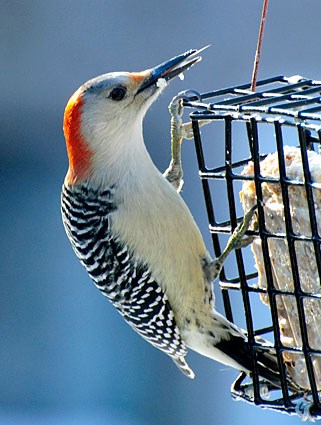
A red-bellied woodpecker!
Copyright: maia bird
I know what you're thinking, this woodpecker doesn't look particularly
red-bellied. Why not call it the red-headed? Well, that name was already
taken. The bird pictured above is a female. You can tell because the red on its head is mostly contained on the back of its head.
Copyright: John Hartgerink
Here's an example of a male red-bellied woodpecker. Its red coloration extends down the front of its head to its beak. They have awesome feather coloration, and it was really stunning up close. Also, take a look at those tail feathers. Woodpeckers all have short, stiff tail feathers used to brace themselves against trees while they peck.
Copyright: Cape Cod Bander
You don't realize it until they're really close, but they also have reddish eyes.
Copyright: Chipper Woods Bird Observatory
Woodpeckers have a cool toe arrangement called "zygodactyl." This means that two of their toes are in the front, and two are in the back. This helps them climb up and down trees, which is why you can see woodpeckers "upside down" on a tree trunk.
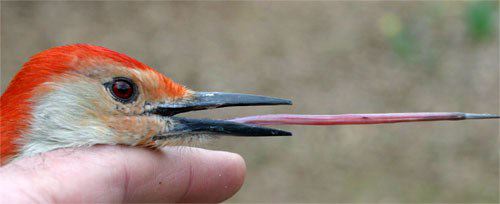
Also, check out their tongues!
Copyright: Hilton Pond Center
The tips of their tongues are hard and barbed, and they use them to spear grubs under the bark of trees. Their tongues are at least THREE TIMES the length of their bills! Pretty neat.
That's all I have for today, hopefully some new and interesting species will be captured the next time we net.
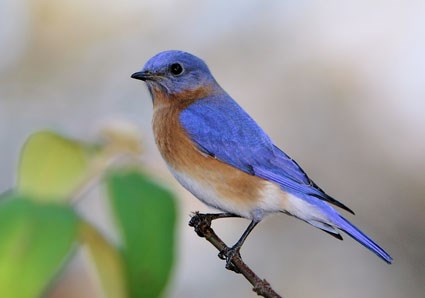
Today's ornithology lab saw us at Lake Hope once more, which was a nice break from netting. We arrived at around 7:45, and temperatures started in the low 60s. Cloud cover was around 50%. For the first few minutes, we were by the dam. We quickly realized that it was an Eastern bluebird kind of day. Somehow, we made it the first half of the semester without seeing any, but today we must have seen two dozen!
Copyright: Debbie McKenzie
Other birds at the dam:
Blue jay
American crow
Belted kingfisher
Canada geese
Carolina warbler
Chipping sparrow
Eastern phoebe
Great blue heron
Wood ducks
Mourning dove
Turkey vulture
At around 8:20, we were at a marshy area, with lots of stumps left over from beaver activity. Our arrival flushed a flock of wood ducks out of the water, and there must have been over thirty of them. As we were watching and listening for birds, we heard a bird singing. It's important to know that there's a difference between a bird "song" and a bird "call." Usually, only male birds "sing," but both males and females will call. Songs are longer and more complicated than calls. Birds generally only sing during the breeding season as a way to attract mates and keep other males out of their territory. The bird singing, it turns out, was a young male song sparrow, and he was practicing his songs to get them ready for the spring. I couldn't really tell a difference in quality, but my instructor said his songs were really bad and that it was good he was practicing!
Other birds at the marsh:
Belted kingfisher (female)
Eastern phoebe
Pileated woodpecker
Eastern towhee
American goldfinch
Cooper's hawk
Yellow-billed cuckoo
Golden-crowned kinglet
Black-throated green warbler
Downy woodpecker
Hairy woodpecker
Our last stop for the day was at the Lake Hope campground, where we arrived at 9:30. There, we saw and heard:
American crow
Eastern bluebird
Dark-eyed juncos
Downy woodpecker
White-breasted nuthatch
Red-bellied woodpecker
Pine warblers
Chipping sparrows
Northern flicker
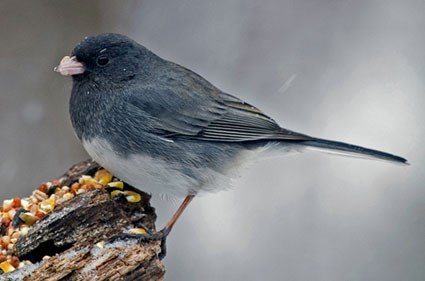
Dark-eyed juncos have lots of color variation, and the kind we have around here are the "slate-colored." Other forms are the "Oregon," "Gray-headed," "Pink-sided," and "White-winged."
Slate-colored; Copyright: Gary Mueller
Oregon; Copyright: Christopher L. Wood
Gray-headed; Copyright: Christopher L. Wood
Pink-sided; Copyright: Christopher L. Wood
White-winged; Copyright: Christopher L. Wood
That's all I have for you this week. Happy birding until next time!
Today was an excellent day to net birds, though it didn't start off very promising. We arrived at the Ridges around 7:15am, and it was a gray and chilly morning. One of the first things we noticed was how quiet it was: very few birds were singing. However, I could identify most of the ones that were making sound. I'm getting a lot better at identifying birds by call, and it's encouraging to see a continual improvement as the weeks go on.
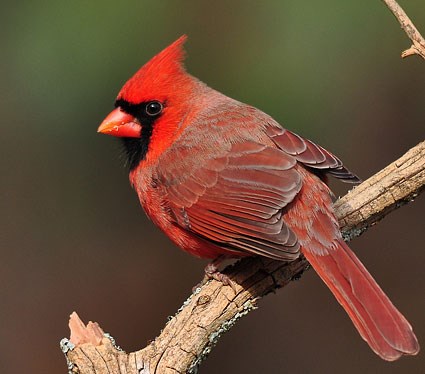
First, of course, was a northern cardinal. Unlike most of the raggedy-looking cardinals we've been catching lately, this one was a bright red male who wasn't molting too badly yet. He looked like an iconic cardinal. By this point, I'm sure you readers are tired of seeing pictures of cardinals on this blog, so I'll spare you.
Bird #2: Magnolia warbler!
Copyright: Cameron Rognan
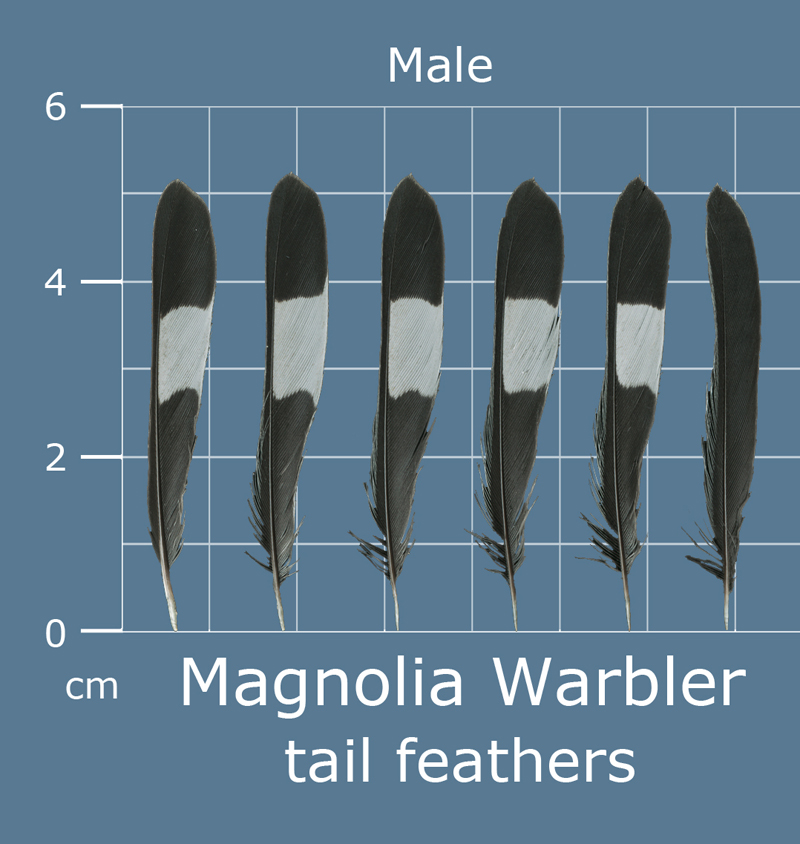
This was our first magnolia warbler, and it was such a charming little bird. We were able to determine that it was a hatch-year bird by which of its feathers had molted by this point. It's harder to identify the sex of juvenile birds, as males and females typically have fewer differences than adults do. The giveaway, however, were the tail feathers, or rectrices.
Copyright: USFWS
Male birds, even as juveniles, will have a large white splotch on their tail feathers, while females have a much smaller white area. Therefore, we were able to determine that our MAWA was a male.
Bird #3: Northern parula
Copyright: Cleber Ferreira
Like the magnolia warbler, the parula is also a warbler. Again, we were able to tell that this bird was a hatch-year bird due to which of its wing feathers had molted. This bird was pretty plump for a warbler, and we could see its large fat stores accumulated for the winter migration.
Bird #4: Tufted titmouse
Copyright: William Jobes
TUTIs are a pretty common backyard bird, and their call of "peter-peter-peter" is also pretty familiar. I had heard that they were a pretty feisty bird to try to hold, and that is not an understatement. They definitely have some sass to be so small. This individual was also a hatch-year bird, which we could tell due to its skull. Like human babies, baby birds aren't born with fully-developed skulls, and their skulls become more bony and reinforced over time. TUTI males and females are usually indistinguishable, so we were unable to tell the sex of this bird.
Bird #5: Swamp sparrow
Copyright: Luckybon
I'm not usually a big fan of sparrows, but this is a really pretty species. They are a rich, reddish-brown color on their heads and in their wings. We were able to determine that this bird was AHY (after hatch year). Again, males and females are very similar, so we were unable to tell the sex of this bird.
Bird #6: ....
Copyright: Cleber Ferreira
What a drab-looking bird, right? When I first saw it, my impression was some kind of sparrow. It didn't cross my mind that I was looking at the juvenile form of THIS bird:
Copyright: Andy Johnson
Colors, it turns out, can be very misleading. We had an indigo bunting! Juvenile males and females look like the brown bird pictured above, and males only grow in their bright blue feathers after they molt their juvenile plumage. Another way we could tell it was a HY bird was by its "gape."
Copyright: East Valley Wildlife Rehabilitation League
Gape refers to how baby birds have really wide beaks that are usually bright orange on the inside. This serves as a "target" for their parents to deposit food in the right place.
By this point, it was 10:45, and six birds was a pretty good day for us. We went to take down the nets and call it a day. The first set of nets went down, no problem. No birds in those. But then we heard the news from the other nets: thirteen more birds. We caught six birds in three hours, and thirteen in the last thirty minutes!
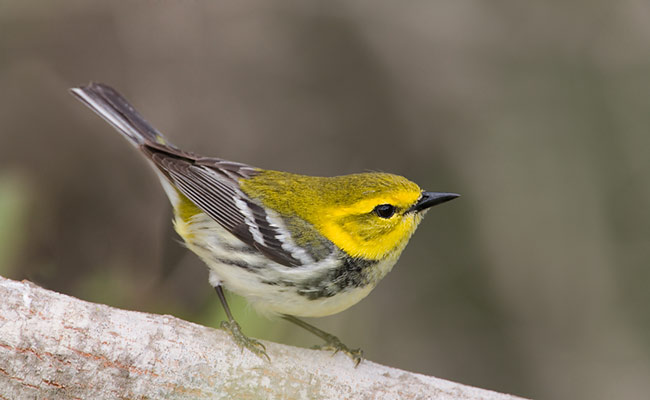
Bird #7: Black-throated green warbler
Copyright: Arthur Morgan
Another new warbler species for the day! We were able to determine that this bird was HY by the molting of its feathers and male by the coloration of its plumage.
Bird #8, 9, 10, 11, 12, & 13...
Copyright: Michael Drummond
Carolina chickadees! SIX of them! We practically caught a flock. All but one of them were HY, and we could tell again by the development of their skulls. Chickadees are nearly impossible to sex, so we were unable to determine the gender of these birds.
#14 & 15: More magnolia warblers!
Both of these were HY determined by molt patterns.
#16, 17, & 18: Tufted titmice
As if we couldn't get enough of their adorable little mohawks.
Last but not least, #19: Blue-headed vireo
Copyright: Jim McCree
This was species I had never heard or seen before, so it was a cool find. We were able to determine that it was HY by feather molt, and its sex was unknown.
Other birds hear and seen today:
Turkey vultures
Red-bellied woodpecker
Carolina wren
American crow
Northern cardinal
Pileated woodpecker
Wood thrush
Downy woodpecker
White-breasted nuthatch
American goldfinch
Rose-breasted grosbeak
Cedar waxwing
Blue jay
Woodpeckers can be hard to distinguish by call, but here are three common Ohio species in order of ascending pitch.
The pileated:
The red-bellied:
The downy:
That's all I have for this week; thanks for reading!
I spent the past weekend in South Carolina with my ornithology class. We left at 8am on Thursday morning, and made it to our campsite on Hunting Island around 9pm that night. Of course, it was pouring rain and we all scrambled to pitch tents while trying to keep our gear dry. Swarms of no-see-ums were attracted to our headlamps and flashlights, and eventually the bite marks made it look like we came down with chicken pox. Exhausted, we all retreated into the tents pretty early and tried to stay dry (didn't work).
We were out by 8am the next morning to look for birds on the island. We began at a lagoon close to our campsite, and the first bird I saw was a bald eagle perched in a tree. Not a bad start, right? In the lagoon we also saw a great blue heron flying overhead. Lots of mourning doves were perched on the telephone wires.
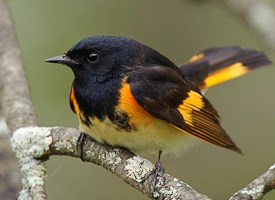
In the pine/oak forest of the island, we saw a couple of tufted titmice, an American redstart, and a downy woodpecker. The American redstart is a species of warbler, and the males are really attractive birds. Here's a picture of a male.
Copyright: Gerrit Vyn
We then went to the beach, where we saw lots of laughing gulls, brown pelicans, and a willet. Willets are funny little shorebirds with long, straight beaks. They're often seen running around on beaches and are a mottled brown color. When their wings are spread, though, you can see the black and white striping, as in the picture below.
Copyright: Greg Page
Laughing gulls are one of the many species of gull that are collectively referred to as "seagulls." All the ones we saw were nonbreeding adults, which look like this:
Copyright: Tim Lenz
This is in contrast to the breeding adults, which have black heads.
Other birds we saw or heard in the forest of the island on Friday were:
Carolina wren
American crow
Pine warbler
Northern mockingbird
Northern cardinal
Blue jay
Carolina chickadee
Merlin--Copyright: Glenn Barkley
Brown-headed nuthatch
Other birds seen on the beach:
Little blue heron (juvenile)
Great egret
Two merlins--These are a species of small falcon that hunt songbirds and small shorebirds
Belted kingfisher
Osprey
Sandpiper flock of around 20 individuals
Double-crested comorants (around 17)
Palm warbler--small bird with yellow rump
Palm warbler--Copyright: Bill Benish
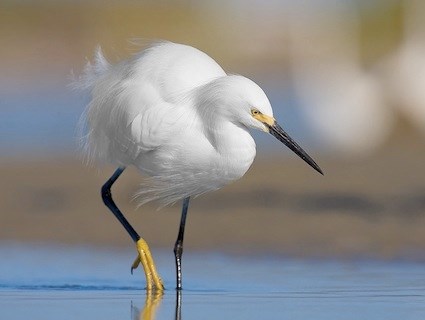
At a marsh a short drive away, we saw several wood storks flying over the marsh. We also saw more great egrets, laughing gulls, a turkey vulture, and a snowy egret.The cool thing about snowy egrets is that they have long black legs, but bright yellow feet!
Snowy egret--Copyright Bill Majoros
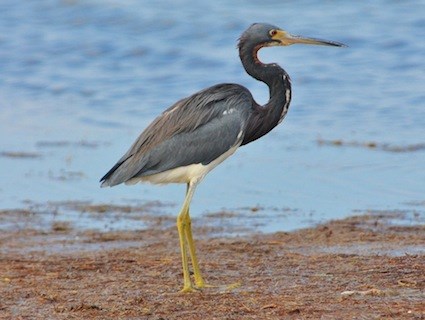
On the Hunting Island Pier, we saw a tri-colored heron, great blue heron, osprety, laughing gulls, brown pelicans, two willets, Caspian terns, black-billed terns, sandwich terns, two black skimmers, and lots of semi-palmated plovers.
Here, you can see a Caspian tern, which is the largest tern in the world!
Copyright: Christopher L. Wood
At the Hunting Island nature center, we heard and saw many more birds, including:
Northern cardinals
Red-winged blackbirds
Mourning doves
Brown-headed nuthatches
Carolina chickadees
Laughing gulls
Osprey
Brown pelicans
Tri-colored heron--Copyright: Glyn Lowe
Here's a black skimmer. Note that the bottom of its bill is longer than the top. That is because it uses the bottom to skim the ocean for fish!
Copyright: Jay Paredes
Whew, so what a day, right? There were so many birds, it was often overwhelming. One girl in my class was wearing a pedometer, and she said we walked over ten miles on Friday. I definitely believe it. Saturday, however, was even more of a workout.
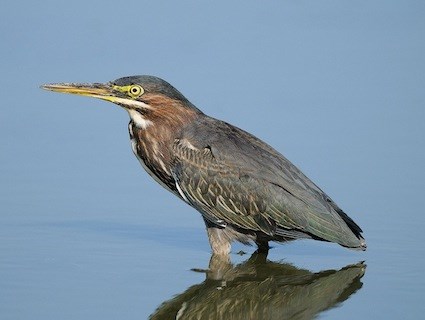
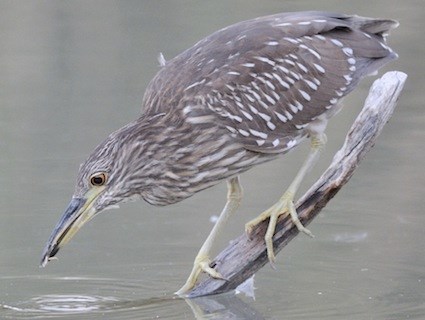
We left around 7:15am to drive to Pinckney Island National Wildlife Refuge, which is in the southern part of the state. We got there around 9am. It was a cool 68 degrees to start with, and totally overcast. My favorite part of this NWR was "Ibis Pond," where we saw dozens of American white ibises, along with fish crows, a juvenile green heron, a juvenile black-crowned night heron, several common gallinules, and an Anhinga in the top of a tree. What wasn't so great about Ibis Pond? Fire ants. I stood right on top of one of their hills and I paid dearly for my mistake.
Juvenile green heron--Copyright: Joel DeYoung
Juvenile black-crested night heron--Copyright: Bill Thompson
Adult common gallinule--Copyright: Bob Hubner
Other birds that we saw or heard in Pinckney NWR were:
Osprey
Tri-colored heron
American crow
Snowy egret
Laughing gulls
Carolina wren
Carolina chickadee
Greater yellowlegs--Copyright: Andy Jordan
Blue jay
Red-bellied woodpecker
Great egret
Greater yellowlegs--This is a kind of sandpiper
Double-crested comorants
Northern cardinal
Wood duck
Pied-billed grebe
Gray catbird
Pileated woodpecker
Pine warbler
Brown-headed nuthatch
Northern mockingbird
After a well-deserved trip to a gas station to buy ice cream, we were on our way to Savannah National Wildlife Refuge. We got there at 3:30pm, and drove a 4 mile loop for wilderness viewing. There was a downpour soon after we arrived, but we waited it out and saw some cool birds. The highlights were definitely a purple gallinule, a great horned owl, another anhinga, a red-shouldered hawk, a Cooper's hawk, a Peregrine falcon, and a Northern harrier hawk.
Anhinga--Copyright: Doug Sonerholm
The anhinga we saw had its wings spread like the one in the picture above. It did this so that it could dry out its wings after the rain. Sometimes it would flutter its wings slightly to help shed water droplets, and that was really interesting to watch.
Purple gallinule--Copyright: Alessandro Abate
Other birds heard and seen at the Savannah NWR included:
Turkey vulture
Mourning doves
Red-winged blackbirds
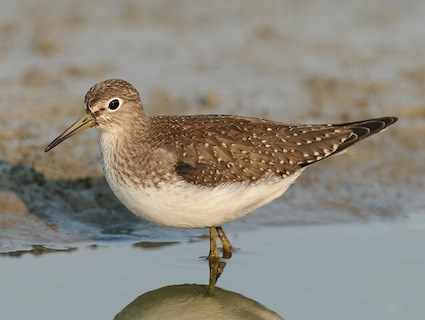
Solitary sandpiper--Copyright: Joel DeYoung
Common gallinules
Common yellowthroat
Song sparrow
Yellow warblers
Killdeer
Sora
Palm warbler
Tri-colored heron
Little blue heron
American coot
Tree swallow
Snowy egret
Solitary sandpiper
Gray catbird
Cattle egret
Boat-tailed grackle
Northern mockingbird
Eastern towhee
American alligators! Not birds, but still pretty cool.
We finally made it back to the campsite at around 9pm after a very exhausting day of birdwatching. The full moon made a perfect night for an impromptu swim in the ocean, so I took advantage of that before eating dinner and heading to bed (yoga mat?). The next day we were on the road by 8:30pm, and back in Athens a short (ha) 12 hours later. Thus concluded my South Carolina birdwatching adventures!
I'll leave you with a picture of a great horned owl!
Today we went bird-watching instead of bird banding, which meant I got to sleep in 15 minutes (yay...). We left campus at 7:00am, and we drove to Lake Hope, which is located within Zaleski State Forest. It was a really clear, sunny morning, with temperatures starting around 65F but warming up to the mid-70s by the time we left around 11am.
We started by walking out on a ridgetop that had been shelterwood cut. This means that all the trees of a certain size were cut, leaving others to keep growing and reseed the area. This first habitat was very open with many grasses and "prairie" plants. I heard and saw many birds, such as:
Blue jay
Pileated woodpecker
White-eyed vireo
White-eyed vireos have variable songs, but they usually have a sharp "chip!" at the end
Carolina chickadee
Downy woodpecker
Gray catbird
Cedar waxwing
These birds fly in large flocks so that they can take advantage of seasonal food sources, such as berries. The more eyes looking for ripe fruit, the better.
Eastern wood-pewee
Like a lot of birds, the pewee got its name from its call. It goes, "peeWEEEEEE"
Eastern screech owl
One of the instructors started doing a screech owl call, and one in the area heard and responded!
American redstart
Rose-breasted grosbeak
Eastern towhee
My peers/instructors heard and saw many others, including:
Tennessee warbler
Prairie warbler
Trail's flycatcher
Bay-breasted warbler
Red-tailed hawk
Black and white warbler
Yellow-billed cuckoo
Yellow-throated vireo
At 9:35, we moved to a new location by the old iron furnace so that we could walk around the lake and look for new species. Unlike the first habitat, which was very open, this second habitat was mostly closed-canopy. Birds that my peers and I saw and heard here included:
Eastern wood-pewee
American goldfinch
Cedar waxwing
White-eyed vireo
Carolina chickadee
Indigo bunting
American crow
Downy woodpecker
Hooded warbler
Tenessee warbler
Blue jay
Gray catbird
Wood duck
Osprey
Red-shouldered hawk
Eastern phoebe
Belted kingfisher
Turkey vulture
Yellow-throated vireo
Red-bellied woodpecker
Pine warbler
Red-tailed hawk
This juvenile hawk came and perched in a tree very close to us, so my class got a great view through our binoculars.
We got to see lots of birds we hadn't seen yet, and I learned a lot of new calls! All in all, it was an excellent morning at Lake Hope.
Today's banding session at the Ridges brought us six birds from three different species. We left campus right at 7am and made it to the Ridges by 7:15. Temperatures started in the high 60s and then rose to the mid 70s as the morning progressed. Humidity was 100%, making it quite uncomfortable. The wind was mostly still, with an occasional light breeze.
First out of the net was...a NOCA!
Copyright: Ed Schneider
This one was a male, unlike the NOCA captured last Wednesday. We could tell that he was at least one year old (AHY) because his bill is bright orange (juveniles will have a dark bill) and because he had bright red plumage. Northern cardinals are notorious for their biting, but I managed to hold this guy without much fuss.
Second bird of the day was a common yellowthroat
Copyright: Bill Thompson
I've actually seen this bird in hand before when I was in Indiana, but I didn't immediately recognize it because the one that I saw was a male, while this one was female (like the above pictured). I'll include the picture I took of the male COYE.
Picture taken at the Indiana Hardwood Ecosystem Experiment (HEE); Bird held by Patrick Ruhl
The common yellowthroat is one of the many species of warblers found in Ohio. We were able to tell that our COYE was AHY by her plumage. Unlike most of the birds we've seen so far, she had started to accumulate fat for migration. You can check for fat deposits on a bird by blowing on their chests to see if the hollow of their clavicle is full or empty. Fat also looks yellowish under their skin.
Copyright: Carnegie Museum of Natural History
For example, in this image, you can see the fat has completely filled in the clavicle. This is one plump songbird!
And then a cardinal...and then another
Copyright: Lisa Barker
The next cardinal was a juvenile, which we were able to tell from its dark bill. Because male birds are not born with their bright red plumage, we were unable to tell if our juvenile was male or female.
Copyright: maia bird
Like last week, another female NOCA! We were able to determine that this one was also AHY by plumage.
A barrage of white-eyed vireos
Copyright: MEK Paasch
For the grand finale, three white-eyed vireos (WEVI) were caught at the same time in the same net. Because they were all juveniles, though, they weren't quite "white-eyed," and instead had grayish eyes like the above pictured.
As you can see, their eyes become more white and piercing as adults. Unlike many bird species, males and females look identical in most cases, so determining the sex without using DNA is usually impossible. We just labeled these three as "unknown" and then sent them on their ways.
I'm currently enrolled in an ornithology class, which is the study of birds. Our first field trip was this morning. We left at 7am this morning to go to the Ridges, which is the site of the former Athens Lunatic Asylum (for those of you not from around here). It's very close, so it was only 7:15 by the time we got there, if that. While it started off pretty comfortable, temperatures quickly rose to the high 70s early in the day. It was a still day with little wind, and little-to-no cloud coverage.
Once we arrived at the Ridges, we had to set up mist nets. I worked with mist nets a lot over the summer when I had my bat internship, and they look like this:
Photo credit:Tommy Thompson Park
They come in variations of length, but all the ones I've seen range from 6m to 18m in length. While bat nets are a little different from bird nets and I'm used to a different setup, the general concept is the same. We set up 8 nets in total, spread out from each other. Nets are often placed in small forest clearings, such as along a trail or a in a powerline corridor.
Altogether, we caught five birds this morning of five different species. While we did take some pictures on the designated ornithology camera, those aren't online yet, so I'll be using other people's pictures. The birds we caught were all "processed," meaning that we banded them, determined their age and sex (if we could), and took measurements. Each band has a unique number, like a serial number for that bird. If the bird is ever captured again, researchers would be able to know where it came from and who banded it. Measurements taken depends on the bander and the research project they might be working on, but common examples are wing chord (wing length) and rectrix length (tail feathers).
This is the northern waterthrush
Copyright: Lloyd Spitalnik
This was the first catch of the day! Like all birds, the northern waterthrush can be identified by a four-letter code, which comes from the bird's name. For example, the northern waterthrush is called "NOWA." It usually isn't found in this area, and must have been passing through on its way south. It's easily confused with another warbler called the Lousiana waterthrush, but it can be differentiated by the black streaking across its throat and its yellowish supercilium (line above the eye) that tapers towards the back of the head. We were able to determine that this bird was a female by wing chord, and her age was AHY (after hatch year). This means that she was born before this summer.
This is a northern cardinal (female)
Copyright: Will Sweet
The northern cardinal (NOCA) is one of the most easily-identified eastern bird, especially the males. Ours, however, was a female, so she lacked the distinctive red plumage. She also still had a brood patch, which is an area of bare skin on a female bird's belly that facilitates heat transfer between her body and her eggs. While the NOWA was banded with an aluminum band, this NOCA got a stainless steel one because her beak is strong enough to bend aluminum. She was also AHY (after hatch year), and we were able to tell this from her brood patch (if she was born this year, she would not have raised chicks).
This is a Swainson's thrush
Copyright: Laura Meyers
On first look, it might appear similar to the NOWA from earlier, but it can be differentiated from other thrushes by its buffy (pale yellow-brown) distinctive eye ring, almost like it's wearing spectacles. Like the NOWA, though, the SWTH usually isn't found in Ohio, and was only passing through on its way south. We couldn't determine the sex of this bird, but its plumage (feathers) showed that it was also AHY.
Next was a chipping sparrow
Copyright: Kelly Colgan Azar
Unlike the first three birds we caught today, this chipping sparrow (CHSP) had hatched this year (age = HY). Because it was a young bird, its plumage looks different from how it will next year. I'll include a picture of an AHY chipping sparrow for comparison:
Copyright: Tom Smith
The adult has a rusty cap and no spotting on the chest and throat. Differences like this can make it hard to identify juvenile birds.
Last but not least, a Carolina chickadee!
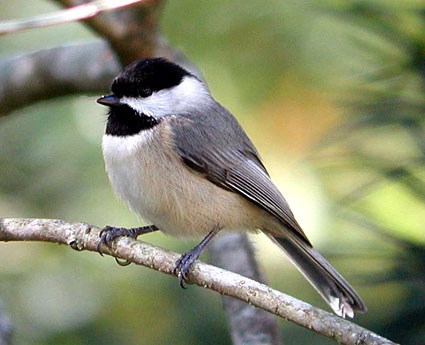
Like the CHSP, this Carolina chickadee was also a juvenile, although its coloration isn't very different from an adult. Sometimes you can determine a bird's age by how "worn out" its feathers are. Carolina chickadees look very similar to black-capped chickadees, but the black-capped usually aren't found this far south in Ohio. We were unable to determine sex in this bird because the males and females appear the same.
In addition to catching these five species, we also heard and saw many more! Some birds that I heard/saw included:
Blue jay
Pileated woodpecker
Tufted titmouse
White-breasted nuthatch
Eastern towhee
American goldfinch
Eastern wood-pewee
White-eyed vireo
Red-bellied woodpecker
Carolina wren
Downy woodpecker
Cedar waxwing
Turkey vulture
American robin
Other birds heard or seen by my peers were:
Yellow-billed cuckoo
Red-eyed vireo
Ruby-throated hummingbird
Northern mockingbird
Mourning dove
That's all I have for you today! Take a look around your own backyard and see what species are coming to visit you; you'll be surprised at how many there are!