Hello again,
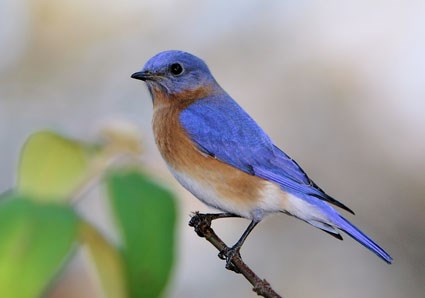
Today's ornithology lab saw us at Lake Hope once more, which was a nice break from netting. We arrived at around 7:45, and temperatures started in the low 60s. Cloud cover was around 50%. For the first few minutes, we were by the dam. We quickly realized that it was an Eastern bluebird kind of day. Somehow, we made it the first half of the semester without seeing any, but today we must have seen two dozen!
 |
| Copyright: Debbie McKenzie |
Other birds at the dam:
- Blue jay
- American crow
- Belted kingfisher
- Canada geese
- Carolina warbler
- Chipping sparrow
- Eastern phoebe
- Great blue heron
- Wood ducks
- Mourning dove
- Turkey vulture
At around 8:20, we were at a marshy area, with lots of stumps left over from beaver activity. Our arrival flushed a flock of wood ducks out of the water, and there must have been over thirty of them. As we were watching and listening for birds, we heard a bird singing. It's important to know that there's a difference between a bird "song" and a bird "call." Usually, only male birds "sing," but both males and females will call. Songs are longer and more complicated than calls. Birds generally only sing during the breeding season as a way to attract mates and keep other males out of their territory. The bird singing, it turns out, was a young male song sparrow, and he was practicing his songs to get them ready for the spring. I couldn't really tell a difference in quality, but my instructor said his songs were really bad and that it was good he was practicing!
Other birds at the marsh:
- Belted kingfisher (female)
- Eastern phoebe
- Pileated woodpecker
- Eastern towhee
- American goldfinch
- Cooper's hawk
- Yellow-billed cuckoo
- Golden-crowned kinglet
- Black-throated green warbler
- Downy woodpecker
- Hairy woodpecker
Our last stop for the day was at the Lake Hope campground, where we arrived at 9:30. There, we saw and heard:
- American crow
- Eastern bluebird
- Dark-eyed juncos
- Downy woodpecker
- White-breasted nuthatch
- Red-bellied woodpecker
- Pine warblers
- Chipping sparrows
- Northern flicker
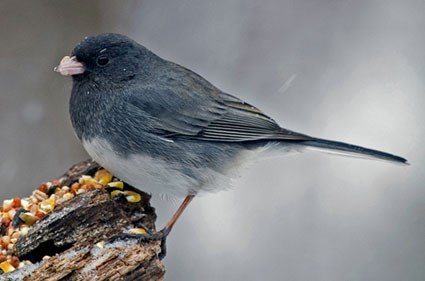
Dark-eyed juncos have lots of color variation, and the kind we have around here are the "slate-colored." Other forms are the "Oregon," "Gray-headed," "Pink-sided," and "White-winged."
 |
| Slate-colored; Copyright: Gary Mueller |
 |
| Oregon; Copyright: Christopher L. Wood |
|
 |
| Gray-headed; Copyright: Christopher L. Wood |
 |
| Pink-sided; Copyright: Christopher L. Wood |
 |
| White-winged; Copyright: Christopher L. Wood |
That's all I have for you this week. Happy birding until next time!


No comments:
Post a Comment