I spent the past weekend in South Carolina with my ornithology class. We left at 8am on Thursday morning, and made it to our campsite on Hunting Island around 9pm that night. Of course, it was pouring rain and we all scrambled to pitch tents while trying to keep our gear dry. Swarms of no-see-ums were attracted to our headlamps and flashlights, and eventually the bite marks made it look like we came down with chicken pox. Exhausted, we all retreated into the tents pretty early and tried to stay dry (didn't work).
We were out by 8am the next morning to look for birds on the island. We began at a lagoon close to our campsite, and the first bird I saw was a bald eagle perched in a tree. Not a bad start, right? In the lagoon we also saw a great blue heron flying overhead. Lots of mourning doves were perched on the telephone wires.
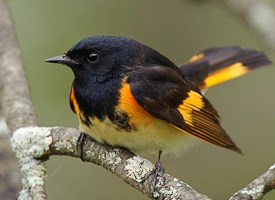
In the pine/oak forest of the island, we saw a couple of tufted titmice, an American redstart, and a downy woodpecker. The American redstart is a species of warbler, and the males are really attractive birds. Here's a picture of a male.
Copyright: Gerrit Vyn
We then went to the beach, where we saw lots of laughing gulls, brown pelicans, and a willet. Willets are funny little shorebirds with long, straight beaks. They're often seen running around on beaches and are a mottled brown color. When their wings are spread, though, you can see the black and white striping, as in the picture below.
Copyright: Greg Page
Laughing gulls are one of the many species of gull that are collectively referred to as "seagulls." All the ones we saw were nonbreeding adults, which look like this:
Copyright: Tim Lenz
This is in contrast to the breeding adults, which have black heads.
Other birds we saw or heard in the forest of the island on Friday were:
Carolina wren
American crow
Pine warbler
Northern mockingbird
Northern cardinal
Blue jay
Carolina chickadee
Merlin--Copyright: Glenn Barkley
Brown-headed nuthatch
Other birds seen on the beach:
Little blue heron (juvenile)
Great egret
Two merlins--These are a species of small falcon that hunt songbirds and small shorebirds
Belted kingfisher
Osprey
Sandpiper flock of around 20 individuals
Double-crested comorants (around 17)
Palm warbler--small bird with yellow rump
Palm warbler--Copyright: Bill Benish
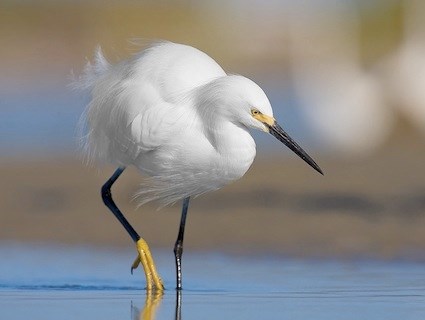
At a marsh a short drive away, we saw several wood storks flying over the marsh. We also saw more great egrets, laughing gulls, a turkey vulture, and a snowy egret.The cool thing about snowy egrets is that they have long black legs, but bright yellow feet!
Snowy egret--Copyright Bill Majoros
On the Hunting Island Pier, we saw a tri-colored heron, great blue heron, osprety, laughing gulls, brown pelicans, two willets, Caspian terns, black-billed terns, sandwich terns, two black skimmers, and lots of semi-palmated plovers.
Here, you can see a Caspian tern, which is the largest tern in the world!
Copyright: Christopher L. Wood
At the Hunting Island nature center, we heard and saw many more birds, including:
Northern cardinals
Red-winged blackbirds
Mourning doves
Brown-headed nuthatches
Carolina chickadees
Laughing gulls
Osprey
Brown pelicans
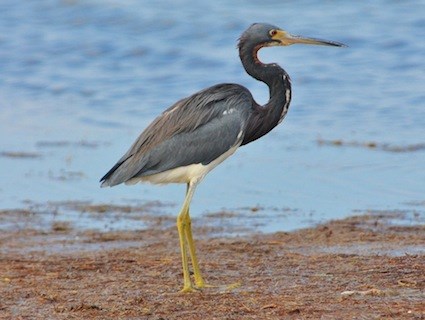
Tri-colored heron--Copyright: Glyn Lowe
Here's a black skimmer. Note that the bottom of its bill is longer than the top. That is because it uses the bottom to skim the ocean for fish!
Copyright: Jay Paredes
Whew, so what a day, right? There were so many birds, it was often overwhelming. One girl in my class was wearing a pedometer, and she said we walked over ten miles on Friday. I definitely believe it. Saturday, however, was even more of a workout.
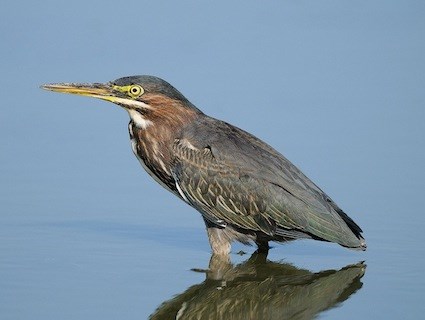
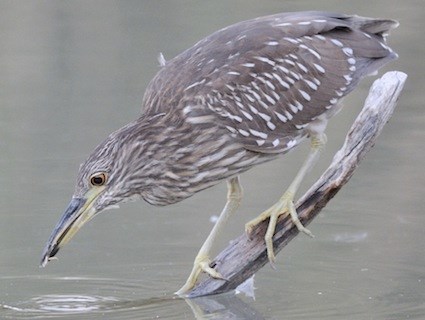
We left around 7:15am to drive to Pinckney Island National Wildlife Refuge, which is in the southern part of the state. We got there around 9am. It was a cool 68 degrees to start with, and totally overcast. My favorite part of this NWR was "Ibis Pond," where we saw dozens of American white ibises, along with fish crows, a juvenile green heron, a juvenile black-crowned night heron, several common gallinules, and an Anhinga in the top of a tree. What wasn't so great about Ibis Pond? Fire ants. I stood right on top of one of their hills and I paid dearly for my mistake.
Juvenile green heron--Copyright: Joel DeYoung
Juvenile black-crested night heron--Copyright: Bill Thompson
Adult common gallinule--Copyright: Bob Hubner
Other birds that we saw or heard in Pinckney NWR were:
Osprey
Tri-colored heron
American crow
Snowy egret
Laughing gulls
Carolina wren
Carolina chickadee
Greater yellowlegs--Copyright: Andy Jordan
Blue jay
Red-bellied woodpecker
Great egret
Greater yellowlegs--This is a kind of sandpiper
Double-crested comorants
Northern cardinal
Wood duck
Pied-billed grebe
Gray catbird
Pileated woodpecker
Pine warbler
Brown-headed nuthatch
Northern mockingbird
After a well-deserved trip to a gas station to buy ice cream, we were on our way to Savannah National Wildlife Refuge. We got there at 3:30pm, and drove a 4 mile loop for wilderness viewing. There was a downpour soon after we arrived, but we waited it out and saw some cool birds. The highlights were definitely a purple gallinule, a great horned owl, another anhinga, a red-shouldered hawk, a Cooper's hawk, a Peregrine falcon, and a Northern harrier hawk.
Anhinga--Copyright: Doug Sonerholm
The anhinga we saw had its wings spread like the one in the picture above. It did this so that it could dry out its wings after the rain. Sometimes it would flutter its wings slightly to help shed water droplets, and that was really interesting to watch.
Purple gallinule--Copyright: Alessandro Abate
Other birds heard and seen at the Savannah NWR included:
Turkey vulture
Mourning doves
Red-winged blackbirds
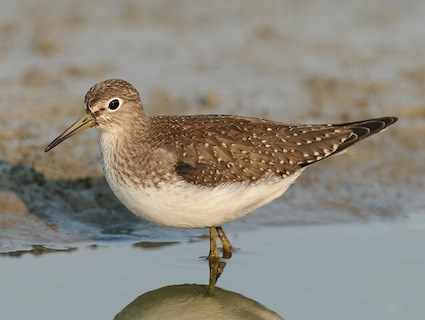
Solitary sandpiper--Copyright: Joel DeYoung
Common gallinules
Common yellowthroat
Song sparrow
Yellow warblers
Killdeer
Sora
Palm warbler
Tri-colored heron
Little blue heron
American coot
Tree swallow
Snowy egret
Solitary sandpiper
Gray catbird
Cattle egret
Boat-tailed grackle
Northern mockingbird
Eastern towhee
American alligators! Not birds, but still pretty cool.
We finally made it back to the campsite at around 9pm after a very exhausting day of birdwatching. The full moon made a perfect night for an impromptu swim in the ocean, so I took advantage of that before eating dinner and heading to bed (yoga mat?). The next day we were on the road by 8:30pm, and back in Athens a short (ha) 12 hours later. Thus concluded my South Carolina birdwatching adventures!
I'll leave you with a picture of a great horned owl!








No comments:
Post a Comment