Today's banding session at the Ridges brought us six birds from three different species. We left campus right at 7am and made it to the Ridges by 7:15. Temperatures started in the high 60s and then rose to the mid 70s as the morning progressed. Humidity was 100%, making it quite uncomfortable. The wind was mostly still, with an occasional light breeze.
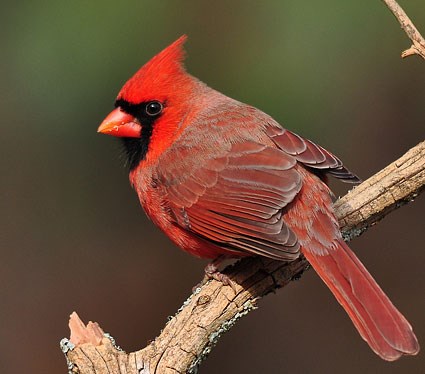
First out of the net was...a NOCA!
 |
| Copyright: Ed Schneider |
This one was a male, unlike the NOCA captured last Wednesday. We could tell that he was at least one year old (AHY) because his bill is bright orange (juveniles will have a dark bill) and because he had bright red plumage. Northern cardinals are notorious for their biting, but I managed to hold this guy without much fuss.
Second bird of the day was a common yellowthroat
 |
| Copyright: Bill Thompson |
I've actually seen this bird in hand before when I was in Indiana, but I didn't immediately recognize it because the one that I saw was a male, while this one was female (like the above pictured). I'll include the picture I took of the male COYE.
 |
| Picture taken at the Indiana Hardwood Ecosystem Experiment (HEE); Bird held by Patrick Ruhl |
The common yellowthroat is one of the many species of warblers found in Ohio. We were able to tell that our COYE was AHY by her plumage. Unlike most of the birds we've seen so far, she had started to accumulate fat for migration. You can check for fat deposits on a bird by blowing on their chests to see if the hollow of their clavicle is full or empty. Fat also looks yellowish under their skin.
 |
| Copyright: Carnegie Museum of Natural History |
For example, in this image, you can see the fat has completely filled in the clavicle. This is one plump songbird!
And then a cardinal...and then another
 |
| Copyright: Lisa Barker |
The next cardinal was a juvenile, which we were able to tell from its dark bill. Because male birds are not born with their bright red plumage, we were unable to tell if our juvenile was male or female.
 |
| Copyright: maia bird |
Like last week, another female NOCA! We were able to determine that this one was also AHY by plumage.
A barrage of white-eyed vireos
 |
| Copyright: MEK Paasch |
For the grand finale, three
white-
eyed
vireos (WEVI) were caught at the same time in the same net. Because they were all juveniles, though, they weren't
quite "white-eyed," and instead had grayish eyes like the above pictured.
As you can see, their eyes become more white and piercing as adults. Unlike many bird species, males and females look identical in most cases, so determining the sex without using DNA is usually impossible. We just labeled these three as "unknown" and then sent them on their ways.
Other birds heard or seen today:
- Tufted titmouse
- Eastern towhee
- Red-bellied woodpecker
- Pileated woodpecker
- Blue jay
- American goldfinch
- American robin
- American crow
- White-breasted nuthatch
- Carolina wren
- Carolina chickadee
- Eastern wood-pewee
- Turkey vulture
- Cedar waxwing
- Red-eyed vireo
Birds heard or seen by my classmates:
- Yellow-throated vireo
- Mourning dove


No comments:
Post a Comment