As much fun as waking up at 6:15am is, that joy is only amplified when it isn't even forty degrees outside. For the first time this season, I wore my winter coat outside, and I did not regret that decision at all!
We left OU at 7:15 to drive to the Ridges, where we netted once again. Despite being totally frigid, it was a clear and sunny morning. Most of the birds we caught today were very common. For example, we caught more Carolina chickadees and tufted titmice. We caught a whopping NINE chipping sparrows. Despite an overall high number of captures, only two of the species today were new to us.
The song sparrow
Copyright: Ed Schneider
The song sparrow is an extremely common bird in the US, and if you haven't seen one, then you've definitely heard one.
While their songs vary regionally, they usually end with that "buzz" or trill sound. You might be thinking that such a common bird isn't really worth getting excited about. That's why I saved our big catch of the day for last:
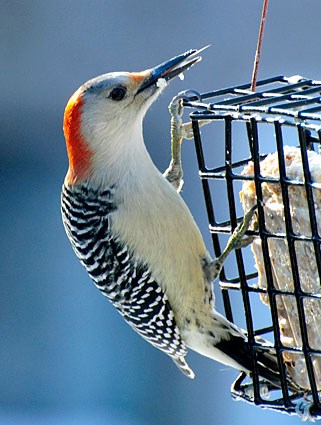
A red-bellied woodpecker!
Copyright: maia bird
I know what you're thinking, this woodpecker doesn't look particularly
red-bellied. Why not call it the red-headed? Well, that name was already
taken. The bird pictured above is a female. You can tell because the red on its head is mostly contained on the back of its head.
Copyright: John Hartgerink
Here's an example of a male red-bellied woodpecker. Its red coloration extends down the front of its head to its beak. They have awesome feather coloration, and it was really stunning up close. Also, take a look at those tail feathers. Woodpeckers all have short, stiff tail feathers used to brace themselves against trees while they peck.
Copyright: Cape Cod Bander
You don't realize it until they're really close, but they also have reddish eyes.
Copyright: Chipper Woods Bird Observatory
Woodpeckers have a cool toe arrangement called "zygodactyl." This means that two of their toes are in the front, and two are in the back. This helps them climb up and down trees, which is why you can see woodpeckers "upside down" on a tree trunk.
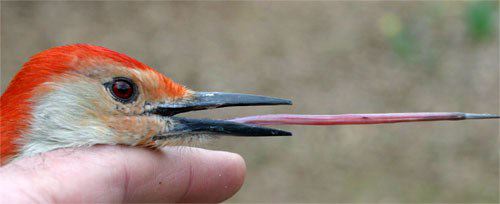
Also, check out their tongues!
Copyright: Hilton Pond Center
The tips of their tongues are hard and barbed, and they use them to spear grubs under the bark of trees. Their tongues are at least THREE TIMES the length of their bills! Pretty neat.
That's all I have for today, hopefully some new and interesting species will be captured the next time we net.
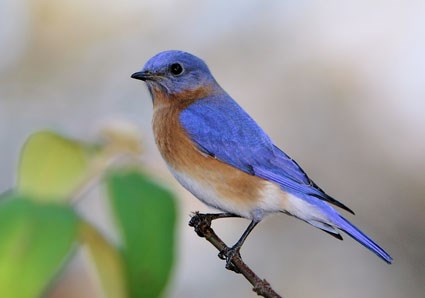
Today's ornithology lab saw us at Lake Hope once more, which was a nice break from netting. We arrived at around 7:45, and temperatures started in the low 60s. Cloud cover was around 50%. For the first few minutes, we were by the dam. We quickly realized that it was an Eastern bluebird kind of day. Somehow, we made it the first half of the semester without seeing any, but today we must have seen two dozen!
Copyright: Debbie McKenzie
Other birds at the dam:
Blue jay
American crow
Belted kingfisher
Canada geese
Carolina warbler
Chipping sparrow
Eastern phoebe
Great blue heron
Wood ducks
Mourning dove
Turkey vulture
At around 8:20, we were at a marshy area, with lots of stumps left over from beaver activity. Our arrival flushed a flock of wood ducks out of the water, and there must have been over thirty of them. As we were watching and listening for birds, we heard a bird singing. It's important to know that there's a difference between a bird "song" and a bird "call." Usually, only male birds "sing," but both males and females will call. Songs are longer and more complicated than calls. Birds generally only sing during the breeding season as a way to attract mates and keep other males out of their territory. The bird singing, it turns out, was a young male song sparrow, and he was practicing his songs to get them ready for the spring. I couldn't really tell a difference in quality, but my instructor said his songs were really bad and that it was good he was practicing!
Other birds at the marsh:
Belted kingfisher (female)
Eastern phoebe
Pileated woodpecker
Eastern towhee
American goldfinch
Cooper's hawk
Yellow-billed cuckoo
Golden-crowned kinglet
Black-throated green warbler
Downy woodpecker
Hairy woodpecker
Our last stop for the day was at the Lake Hope campground, where we arrived at 9:30. There, we saw and heard:
American crow
Eastern bluebird
Dark-eyed juncos
Downy woodpecker
White-breasted nuthatch
Red-bellied woodpecker
Pine warblers
Chipping sparrows
Northern flicker
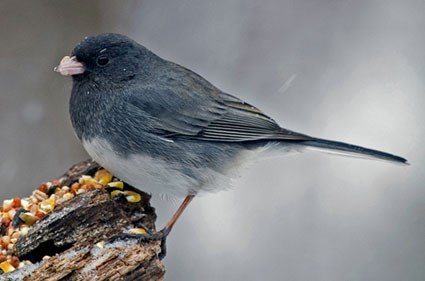
Dark-eyed juncos have lots of color variation, and the kind we have around here are the "slate-colored." Other forms are the "Oregon," "Gray-headed," "Pink-sided," and "White-winged."
Slate-colored; Copyright: Gary Mueller
Oregon; Copyright: Christopher L. Wood
Gray-headed; Copyright: Christopher L. Wood
Pink-sided; Copyright: Christopher L. Wood
White-winged; Copyright: Christopher L. Wood
That's all I have for you this week. Happy birding until next time!